Halloween is close, and you've already had a customer ask if you "do Christmas lights." You've got the ladder in the truck, and it looks like easy money in a slow stretch. Here's my answer: yes, take the work if you stick to plug-in lights hung from a ladder, charge a fair price, and turn down the jobs that are too steep, too high or too icy. Below is what can actually hurt you, what to check on your license and insurance, what to charge, and what to tell the customer about the ladder and the roof.
Should you do it?
For most one-man handyman shops I think it's worth doing. The work comes in the fall, when other jobs slow down. A customer who likes how the house looked usually calls you again the next year, so a few houses this year can turn into a regular holiday route. And you get paid twice: once in November to put the lights up and again in January to take them down. That January visit is also a chance to hear about the gutter that's pulling loose or the trim that needs paint.
The downside is the ladder. Customers almost never get mad about lights. What hurts people doing this work is falling. If you take these jobs, set some rules before the first call and stick to them: plug-in lights only, work from the ladder and not the roof, and no work in bad weather. The rest of this article is about those rules.
The real risk
The Consumer Product Safety Commission estimated about 14,700 emergency-room visits from holiday decorating injuries in the 2016 season. That's about 240 a day in November and December. Falls made up 41% of the most frequent injuries, and three of the deaths that season involved falls from ladders.
The CDC found the same pattern in older data. In the 2000–2002 seasons there were about 5,800 ER-treated decorating falls each year, and ladders caused 43% of them, more than roofs, furniture, stairs or porches. The most common injury was a broken bone, and about half of those breaks came from ladder falls.
Those numbers are mostly homeowners who climb a ladder once a year. You do it for a living. You'll be up and down at several houses a season, often in the cold and the early dark, and that adds up to a lot more time on a ladder than any homeowner spends. OSHA's ladder rules are written for workplaces, not for homeowners hanging their own lights. Once someone pays you, you're working, so hold yourself to the work rules.
What to tell the customer about the ladder and the roof
Tell the customer how you work before you give them a price, so nobody is surprised on install day. This is the script I'd use:
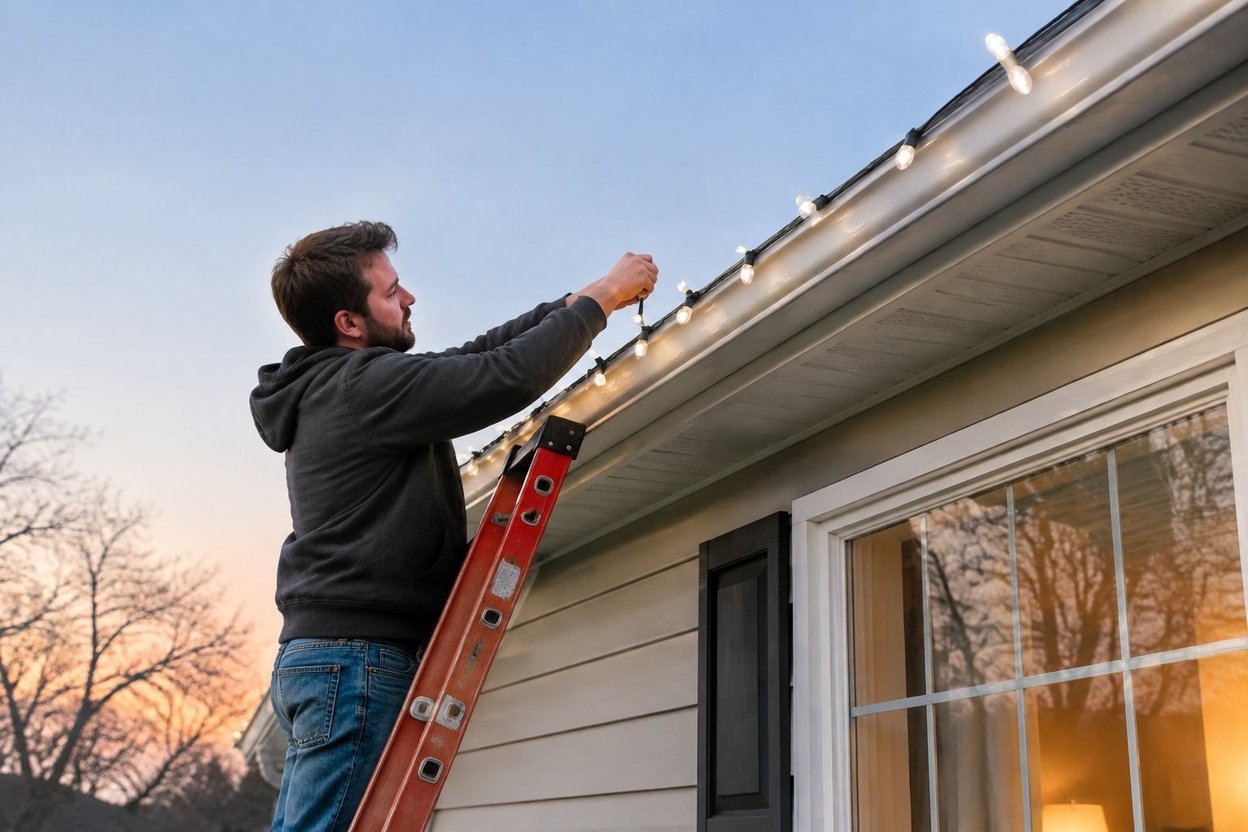
"I hang everything from an extension ladder. I don't walk on the roof. I attach the lights with plastic clips, not nails or staples, so I'm not putting holes in your roof or gutters. If it's icy, snowy or raining, I reschedule. I don't hang lights on wet shingles."
Each part of that has a good reason behind it. Roofing makers say small nail and staple holes can leak, and that walking on shingles can knock granules loose. They also say most roof damage happens when the lights come down, not when they go up, so clips matter at take-down too.
These are the ladder setup rules I'd follow every time:
- Set the feet on firm, level ground.
- Use the 4-to-1 rule: for every 4 feet of height, put the base 1 foot out from the wall.
- Run the ladder at least 3 feet past the roof edge, or tie it off at the top. OSHA's standard requires this for portable ladders used to reach an upper landing.
- Keep your belt buckle between the rails. Move the ladder instead of reaching.
- Stay off the top two rungs.
- Use a ladder standoff so the ladder doesn't rest its weight on the gutter.
This is what I'd say no to: steep roofs, anything taller than your ladder setup can safely reach, and any job where the only way to do it is to walk the roof. Tell the customer that up front. Most people will respect it, and the ones who don't would have been trouble anyway.
Also check the customer's lights before they go up. CPSC says to use outdoor-rated lights and cords that a recognized testing lab has listed, throw out any strand with cracked sockets or bare wire, and plug outdoor lights into a GFCI-protected outlet.
License and insurance check
License. Most states let handymen work without a contractor's license as long as each job stays under a dollar limit. That limit is often $500 to $1,000 including labor and materials. Arizona's is $1,000, and Arkansas's is $2,000 for residential work. Electrical work usually needs a license at any size. Hawaii treats installing lighting fixtures as electrical work and says that splitting one job into several invoices to stay under the limit doesn't count. Plugging lights into an existing outlet is different from adding an outlet, a timer circuit or anything hard-wired. I don't know of a state rule that names Christmas lights specifically. Call your state contractor board, ask where plug-in decorative lighting falls, and write down what they tell you.
Insurance. Call your agent and ask straight out: "Does my general liability cover installing holiday lights, and is there a height limit?" Some policies sold for this kind of work exclude anything above two stories, don't cover injuries to the owner or employees, and exclude electrical work that should have been done by a licensed electrician. Your policy's wording is what counts, so get the answer in writing. Remember that general liability covers damage to the customer's house. It usually doesn't cover your own broken wrist.
Expect to be asked for proof. Consumer news stories tell homeowners to ask installers for proof of commercial general liability that covers a fall from the roof or damage to the house. They also point out that if the lights start a fire, the homeowner's insurer pays first and then goes after the contractor's coverage. Keep your certificate on your phone so you can send it the same day someone asks.
Pricing and the quote
Consumer cost guides from 2025 put labor only, using the customer's lights, at about $2 to $5 per foot, and up to around $7 in expensive cities. Installing your own lights runs about $5 to $10 per foot, and premium custom work $8 to $15. One guide gives the national average as about $442, with most jobs between $220 and $685. A basic single-story roofline runs about $250 to $600. Those are national estimates, and some guides list lower numbers, so look at what's normal in your area and set your price from there.
Whatever price you land on, put these in writing:
- Take-down. Say whether it's included or priced separately. Removal on its own often runs $100 to $400. If it's included, put a date range on it.
- Whose lights. Say whether you're hanging the customer's lights or supplying your own, and who replaces a strand that dies.
- Weather. Say that you reschedule for ice, snow or rain.
- Method. List your rules: clips only, no roof walking, plug-in only, and your height limit.
A one-page written agreement with those items keeps the January visit from turning into an argument.
Next step
Do these four things this week, before Thanksgiving fills up your calendar:
- Call your insurer. Ask about holiday lighting and the height limit, and get the answer in writing.
- Pick your price. Choose a per-foot rate and a minimum, and decide whether take-down is included.
- Write your script. Use the ladder-and-roof speech above, in your own words, and save it so you can paste it into a text.
- Set your height cutoff. Decide the tallest and steepest house you'll do, and turn down anything past it without second-guessing.
None of this takes long. If you give it fifteen to thirty minutes on three evenings this week, you'll be set up before the first customer asks.
Sources (13)
- CPSC: Put Safety at the Top of Your List When Decorating this Holiday Season
- CDC archive: Holiday decorating falls and ladder safety
- OSHA standard interpretation, 29 CFR 1926.1053(b)(1)
- Safety Now: Ladder safety stats and facts
- GAF: Tips for installing holiday roofing decorations
- IKO: How to hang Christmas lights on a shingle roof
- Ware Learning Center: How to install Christmas lights on a roof
- Next Insurance: Handyman license requirements
- Bob Vila: Does a handyman need a license?
- Hawaii Legislature SB767 SD1
- Insurance Canopy: Christmas light installation insurance
- KSAT: Dangling dangers of putting up Christmas lights
- ThePricer: How much does Christmas light installation cost?