The first real snow comes down sometime between Halloween and Thanksgiving, and the phone rings. A homeowner has a stain on the ceiling or some siding that looks wrong, and they want a price this week. You pull into the driveway and the roof is white from ridge to gutter. Drifts cover the bottom of the walls. Here's how to handle it. Give a fixed price for the work you can see and a per-sheet or per-foot price for the work you can't. Write down what the snow hid, and do no extra work until the customer signs off on it.
The short answer
Don't price a surprise. If you guess at hidden damage and guess low, the rot comes out of your pocket. If you pad the price to cover it, you lose the job to someone who didn't.
The roofing trade dealt with this long before snow came into it. A Florida roofing law article says a roofer "rarely" knows how much of the deck is bad until the old roof is off, and that deck conditions are often unknown at the estimate. It also says most roofing contracts include a time-and-materials provision for replacing decking as needed. Siding works the same way. A siding contractor quoted in Pro Remodeler put it this way: "Change orders shouldn't happen with siding, but they do." That usually happens when the upfront look at the job was skipped.
So the rule is the same in July and in January:
- Give a fixed price for the part you can see and measure.
- Give a unit price for the part you can't see, like decking per sheet or sheathing and trim per foot.
- Write down what's unknown.
- Get a signed yes before any extra work.
Snow doesn't change the rule. It just makes the unknown part bigger. That's why the checking you can still do matters.
What you can still check in winter
You can't see the shingles, but a snowy roof will still show you plenty.
Start inside. The attic is open to you year-round, and it often tells you more than the shingles would. Look for wet or matted insulation near the eaves, frost or dark spots on the sheathing, and stains where the ceiling meets the outside walls. Those are the usual signs of ice dams. If you carry a moisture meter, use it on framing that looks suspect.
Check the edges. At the rakes and eaves, the exposed edges show how many layers are on the roof. Two layers change your tear-off price, so you want to know that before you write a number.
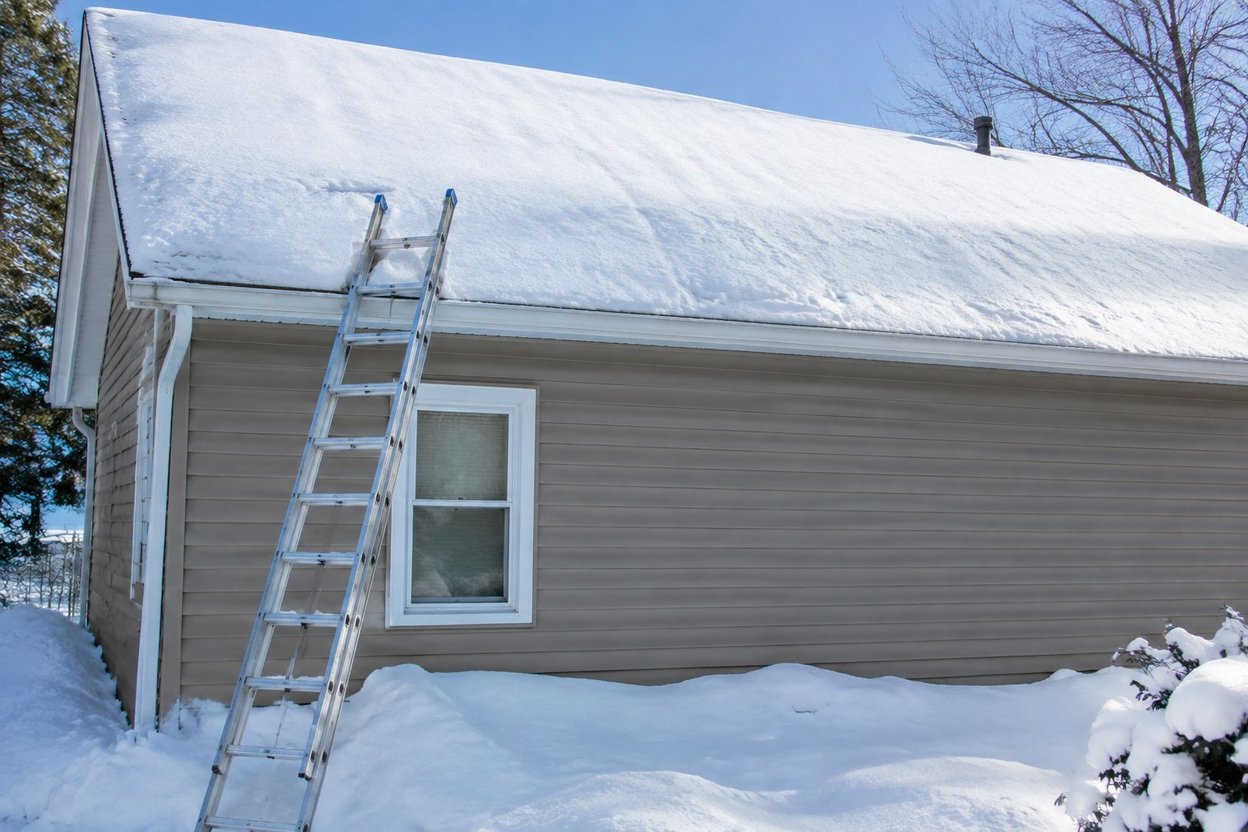
Brush a few spots from the ladder. Home inspectors do the same thing. They lean a ladder against the roof in several places and clear a few small areas, mostly on the south-facing slopes where the snow is thinnest. One inspection firm admits this shows only a small part of the roof. It also says clearing the whole roof isn't practical, because it would take hours under rope and harness. Stay off a snow-covered roof. No quote is worth that fall.
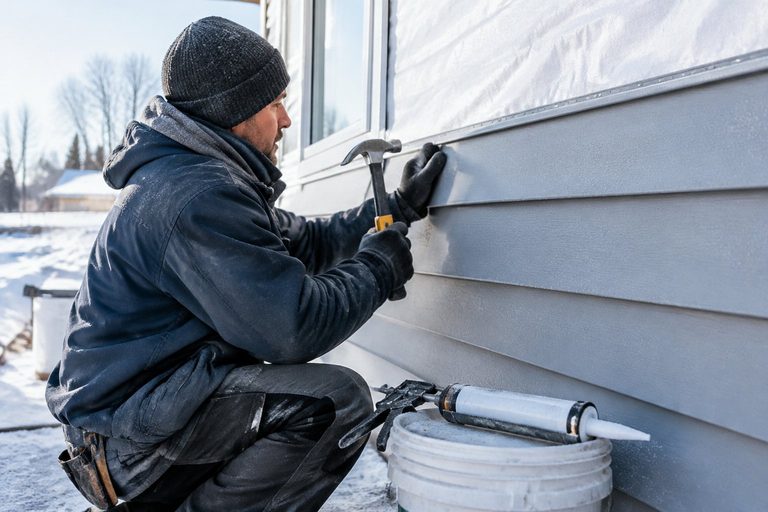
For siding, work around the whole house, not just the wall the customer pointed at. Pro Remodeler says experienced estimators check under the siding at the base of the house and around the windows for signs of water. Add the joints where a roof meets a wall, because water gets in there too.
Take photos of everything you check, and of the spots you couldn't get to.
Unit prices and allowances
Even after all that checking, some of the job is still unknown, and a unit price covers it. You can't know how many sheets of decking are bad, but you can know what each one costs. Set that number now, while nobody is upset.
The roofing law article gives a sample clause where the customer pays a stated amount per plywood sheet replaced, without needing a written change order each time. Here's how it looks in real paperwork. One roofing estimate lists rotted decking at $75 per sheet. Another contractor's terms page lists $60 per sheet. Each is one contractor's document, from an unknown place and year. They are not market prices. Work out your own rate from your material cost, your labor and the time it takes to cut out and replace a sheet.
Public bids handle the same problem in different ways. One Florida county bid addendum covers hidden decking damage with a contingency and includes a $1,200 allowance for wood repair. Another addendum from the same county says the bid has to include all costs. Either approach works if it's written down before work starts.
For siding, set a rate per sheet of sheathing and a rate per linear foot of rotted trim. Some siding contractors also build extra labor hours into the install to cut down on change orders. That's a reasonable call if you know the age of houses in your area.
Whatever you charge, make the approval step part of the price: you find it, you photograph it, the customer sees it, then you replace it. Pro Remodeler suggests putting photos of existing trouble spots into the proposal and the job folder so both sides have the same record.
Wording to put in the quote
The unit prices only protect you if they're written into the quote. Here's what it should say, in plain words:
- The date and the conditions. For example: "Inspected [date]. Roof was snow-covered at the time of inspection."
- What you saw and what you didn't. List the attic, the eaves, the brushed-off spots and the wall bases you checked. Inspectors advise listing what they didn't see and marking a partly visible roof face as not visible. Do the same, as in "North slope: not visible."
- The fixed price, for the work you could see and measure.
- The unit prices, for example: "Replacement of damaged roof decking: $___ per sheet. Damaged wall sheathing: $___ per sheet. Rotted trim: $___ per linear foot."
- The approval rule: "No hidden-damage repair will be done without the owner's written approval. Damaged areas will be photographed and shown to the owner before replacement."
- What happens when the snow is gone. Pick one and write it in: "This price is confirmed once the roof is clear and re-inspected," or "Decking will be inspected at tear-off and billed at the unit price above." Inspectors who see a snowy roof tell the client the same thing: the roof is unknown, and it should be checked again when it clears.
Rules for home-improvement contracts and change orders vary by state, and many states require specific terms or notices. Check with your state's contractor licensing board before you use any of this wording.
Cold-weather work and when to wait
Once you have the job, you still have to decide when to do it.
GAF's cool-weather guidance says asphalt shingles lose flexibility below 40°F and can crack. It recommends storing them at about 70°F for at least 24 hours before installing. GAF's hand-sealing bulletin lists cold-weather installs among the cases where shingles should be hand-sealed with roofing cement. That's more labor, and your price should include it. GAF warranty language also says shingles put on in fall or winter may not seal until spring. GAF recommends its leak barriers for installation between 45°F and 120°F air temperature. These come from one manufacturer, so check the instructions for whatever product you're using.
That leaves you two honest options:
- Quote now and schedule later. Sign the job with the provisional wording above and put it on the calendar for a clear, warmer stretch. The customer has a price and a spot in line.
- Wait to quote. If the snow hid too much for even a provisional number to mean anything, say so. Make a quick fix if there's an active leak, and come back to give the full price when the roof is clear.
Either way, the customer knows where they stand, and that matters more than how fast you get the number to them.
Talking it over with the customer
The written terms only work if the customer understands them before signing. Pro Remodeler quotes a remodeler who said: "Most homeowners are okay with paying for additional work if they've been prepped for the possibility." In one case it describes, clients who had been warned up front accepted a change order of about $15,000 for a rotted deck band board.
So prepare them. Sit at the kitchen table and go through the photos with them: the attic, the eave edges, the spots you brushed off. Then say it plainly: "This is what I could see. This is what I couldn't. If there's bad wood under there, here's what each sheet costs, and I'll show it to you before I touch it."
A customer who hears that in November usually doesn't argue when you call them out to the truck in March to look at a soft sheet of decking.
Sources (14)
- Florida Roofing and Sheet Metal Contractors Association: Addressing Self-Adhered Underlayment in Contracts
- Pro Remodeler: Setting Siding Standards
- Structure Tech: How do you inspect a snow-covered roof?
- AHIT home inspection training column
- Homes MSP: How do you inspect a snow-covered roof?
- Homes & Gardens: Ice dam warning signs after snow
- Contractor terms and conditions (per-sheet decking rate)
- Polk County, FL Bid 26-117 Addendum 3
- Polk County, FL Bid 26-118 Addendum 2
- InterNACHI forum: Inspections in the snow
- GAF: Cool-weather roofing tips
- GAF Technical Bulletin R-114: Hand-Sealing Shingles
- GAF: Installing Timberline HDZ shingles in different seasons
- InspectAPedia: Self-sealing asphalt shingle failures (GAF warranty language)